
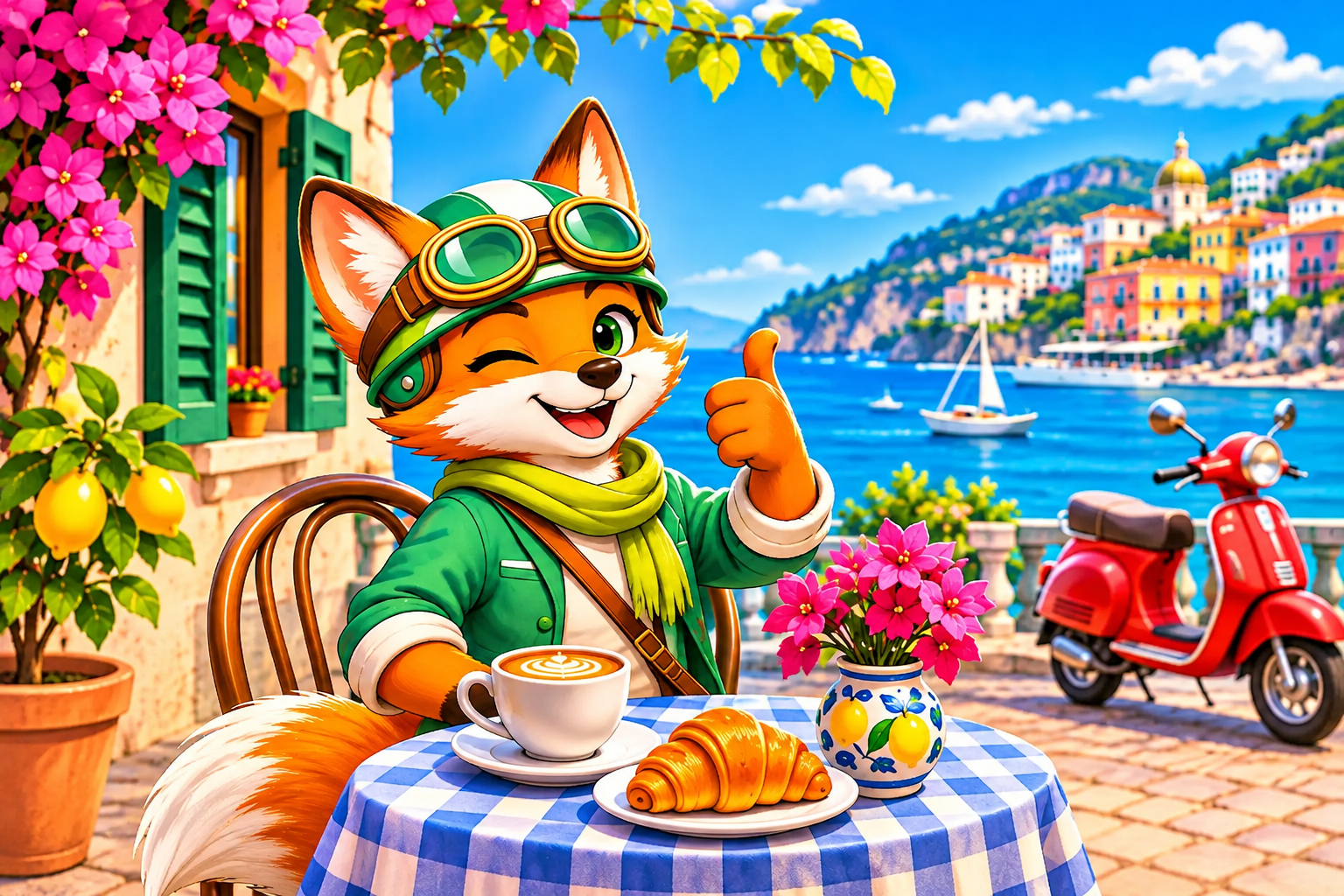
Milo the Vespa Fox enjoying a cappuccino at an Italian coastal café, with a red Vespa and Mediterranean village in the background.
Planning a trip to Italy? Whether you're enjoying an espresso in Rome, wandering through Florence's historic streets, or discovering a seaside village along the Amalfi Coast, learning a few Italian phrases can make your journey more rewarding.
You don't need to speak Italian fluently to connect with locals. A friendly buongiorno, a polite per favore, or a simple question can help you navigate everyday situations and experience more of Italy beyond the typical tourist attractions.
Here are 25 essential Italian phrases for travelers, complete with English translations, beginner-friendly pronunciation guides, and practical tips for using them.
1. Greetings and Everyday Courtesy
In Italy, greetings are an important part of everyday interactions. Whether you're entering a small shop or ordering coffee, a friendly greeting is a great way to start.
1. Buongiorno!
Good morning! / Good day!
Pronunciation: bwohn-JOR-noh
Use buongiorno during the morning and daytime. It's a polite greeting when entering shops, cafés, and restaurants.
2. Buonasera!
Good evening!
Pronunciation: bwoh-nah-SEH-rah
Use this greeting later in the day or in the evening. The exact time people switch from buongiorno to buonasera varies by region and situation.
3. Ciao!
Hello! / Goodbye!
Pronunciation: chow
One of Italy's best-known words. Ciao is informal and works well with friends and people you know. With strangers, buongiorno or buonasera is generally more appropriate.
4. Per favore.
Please.
Pronunciation: pehr fah-VOH-reh
A simple expression that makes requests more polite.
5. Grazie!
Thank you!
Pronunciation: GRAHT-tsyeh
Use grazie whenever someone helps you or provides a service. For extra emphasis, say grazie mille — thank you very much.
Cultural tip: In smaller Italian shops, it's customary to greet the person working there when you enter and say goodbye when you leave. Even a simple buongiorno and arrivederci can make the interaction more pleasant.
2. Introducing Yourself and Communicating
A few conversational expressions can help you connect with people, ask questions, and handle situations when you don't understand everything being said.
6. Mi chiamo...
My name is...
Pronunciation: mee KYAH-moh
Use this when introducing yourself. For example, Mi chiamo Luca means “My name is Luca.”
7. Piacere!
Nice to meet you!
Pronunciation: pyah-CHEH-reh
A friendly expression when meeting someone for the first time.
8. Parla inglese?
Do you speak English?
Pronunciation: PAR-lah een-GLEH-zeh
A polite way to ask someone whether they speak English. This form is appropriate when addressing a stranger or someone you don't know well.
9. Non capisco.
I don't understand.
Pronunciation: nohn kah-PEES-koh
Useful when someone speaks too quickly or uses unfamiliar vocabulary.
10. Può ripetere, per favore?
Could you repeat that, please?
Pronunciation: pwoh ree-PEH-teh-reh pehr fah-VOH-reh
A polite way to ask someone to repeat what they've said.
Travel tip: If you don't understand someone, don't immediately switch to English. Try Non capisco or Può ripetere, per favore? first. These simple exchanges can help you build confidence.
3. Ordering Food and Drinks
Food is a central part of Italian culture. From neighborhood trattorias to bustling cafés, knowing a few phrases can make dining more enjoyable.
11. Un tavolo per due, per favore.
A table for two, please.
Pronunciation: oon TAH-voh-loh pehr DOO-eh pehr fah-VOH-reh
Change due to the number of people in your group. For example, tre means three and quattro means four.
12. Vorrei un caffè, per favore.
I would like a coffee, please.
Pronunciation: vohr-RAY oon kahf-FEH pehr fah-VOH-reh
In Italy, ordering un caffè generally means an espresso. If you prefer a larger coffee, ask for un caffè americano.
13. Posso vedere il menù?
May I see the menu?
Pronunciation: POHS-soh veh-DEH-reh eel meh-NOO
Useful when sitting down at a restaurant or café.
14. Che cosa mi consiglia?
What do you recommend?
Pronunciation: keh KOH-zah mee kohn-SEEL-yah
A great question when you're interested in local specialties or want to discover something beyond familiar dishes.
15. Il conto, per favore.
The bill, please.
Pronunciation: eel KOHN-toh pehr fah-VOH-reh
In many Italian restaurants, the waiter won't automatically bring the bill when you've finished eating. You can request it when you're ready.
A Simple Restaurant Conversation
Imagine you're enjoying dinner at a small trattoria in Florence.
Waiter: Buonasera! Desidera?
Good evening! What would you like?
You: Vorrei una pizza margherita, per favore.
I would like a Margherita pizza, please.
Waiter: Da bere?
Something to drink?
You: Un'acqua naturale, grazie.
Still water, thank you.
After your meal:
You: Il conto, per favore.
The bill, please.
Even if you only remember a few expressions, you can handle a simple restaurant interaction with confidence.
Cultural tip: In Italy, a bar is often a café serving espresso, pastries, and light snacks. Ordering coffee at the counter is common, and prices can differ between standing at the counter and sitting at a table, particularly in tourist areas.
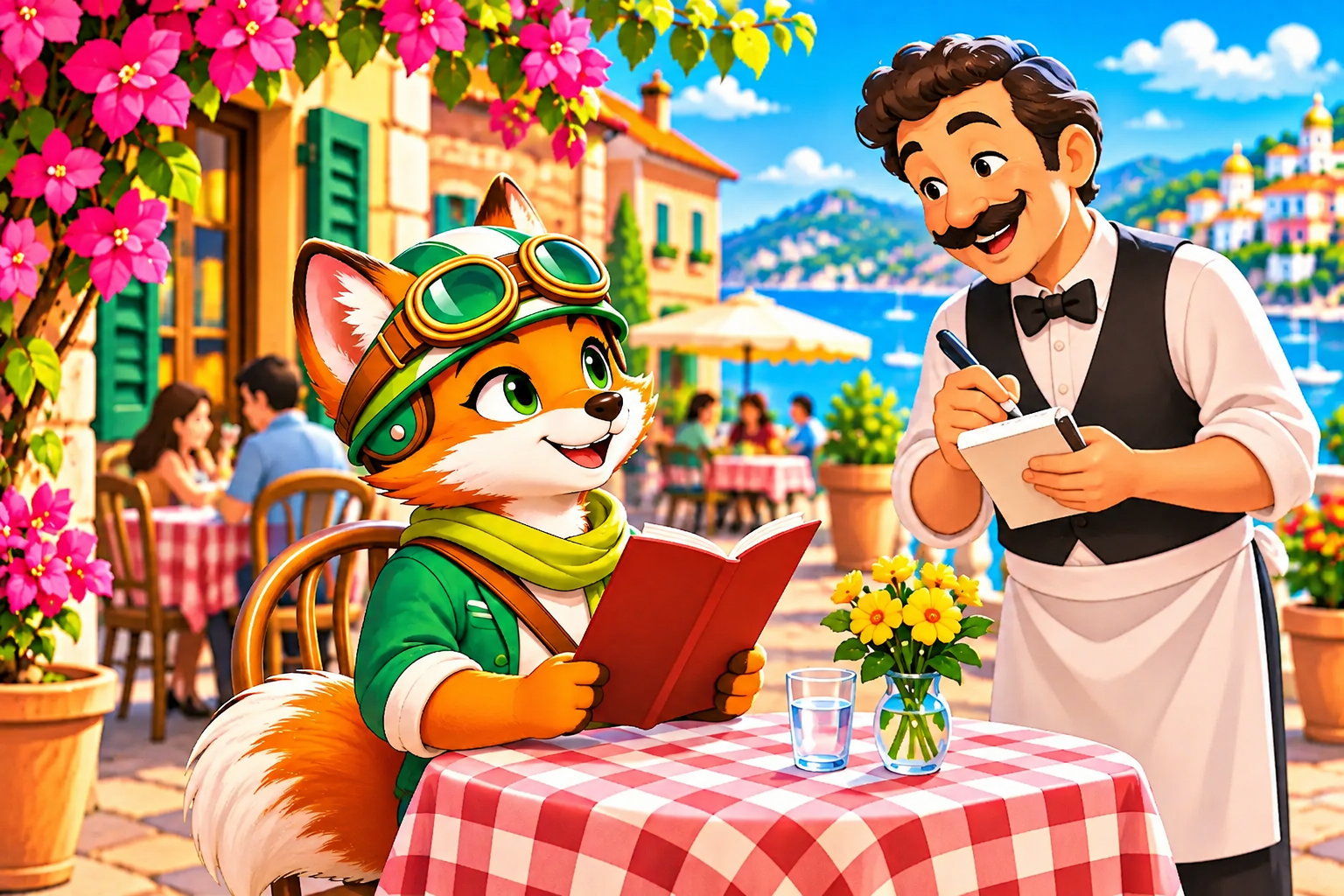
Milo the Vespa Fox practicing Italian with a friendly waiter at a colorful outdoor trattoria overlooking the Mediterranean Sea.
4. Asking for Directions and Getting Around
Italy is full of winding streets, historic neighborhoods, and train connections between cities. These expressions can help you find your way.
16. Dov'è la stazione?
Where is the train station?
Pronunciation: doh-VEH lah staht-TSYOH-neh
Especially useful when traveling between Italian cities by train.
17. Dov'è il bagno?
Where is the bathroom?
Pronunciation: doh-VEH eel BAHN-yoh
One of the most practical questions to remember while traveling.
18. Come arrivo al centro
How do I get to the city center?
Pronunciation: KOH-meh ahr-REE-voh ahl CHEN-troh
Useful when arriving in a new town or looking for its historic center.
19. È lontano?
Is it far?
Pronunciation: eh lohn-TAH-noh
A simple follow-up when asking for directions.
20. A destra o a sinistra?
To the right or to the left?
Pronunciation: ah DEH-strah oh ah see-NEE-strah
Two essential direction words: destra means right and sinistra means left.
Travel tip: Many Italian cities have a centro storico, or historic center, where you'll find landmarks, cafés, and pedestrian streets. Asking for the centro storico can be particularly useful when exploring a new destination.
5. Shopping and Everyday Situations
Whether you're browsing a local market, buying a souvenir, or asking for help, these expressions can make everyday situations easier.
21. Quanto costa?
How much does it cost?
Pronunciation: KWAHN-toh KOH-stah
Perfect for markets, souvenir shops, and small businesses.
22. Posso pagare con la carta?
Can I pay by card?
Pronunciation: POHS-soh pah-GAH-reh kohn lah KAR-tah
Useful when checking whether a business accepts credit or debit cards.
23. Sto solo guardando, grazie.
I'm just looking, thank you.
Pronunciation: stoh SOH-loh gwar-DAHN-doh GRAHT-tsyeh
A polite response when a shop assistant offers assistance.
24. Mi può aiutare?
Can you help me?
Pronunciation: mee pwoh ah-yoo-TAH-reh
A useful expression whenever you need assistance.
25. Mi sono perso / persa.
English: I'm lost.
Pronunciation: mee SOH-noh PEHR-soh / PEHR-sah
Use perso if you're male and persa if you're female.
Cultural tip: Italian markets are wonderful places to practice simple phrases. Start with a greeting, ask Quanto costa?, and finish with Grazie. Even a brief interaction gives you an opportunity to use Italian in a real-world setting.
How to Pronounce Italian More Naturally
How to Pronounce Italian More Naturally
Italian pronunciation is relatively consistent once you understand a few basic patterns. Here are four helpful rules for beginners.
1. Pronounce the vowels clearly.
Italian vowels are generally pronounced more consistently than English vowels.
A sounds approximately like the “a” in father.
E can sound like the vowel in bed or a more closed “eh.”
I sounds like “ee” in see.
O can be open or closed, somewhat like different versions of “oh.”
U sounds like “oo” in food.
2. Pay attention to double consonants.
Italian distinguishes single and double consonants. For example, pala (shovel) and palla (ball) are different words. Hold the double consonant slightly longer.
3. Learn a few special letter combinations.
GN, as in bagno, sounds similar to the “ny” in canyon.
CH, as in chi, produces a hard “k” sound.
CI, as in ciao, generally produces a “ch” sound.
GLI, as in famiglia, represents a sound similar to a blended “ly,” though the Italian sound is distinct.
4. Listen for word stress.
Some syllables are emphasized more than others. In the pronunciation guides above, CAPITAL LETTERS indicate the stressed syllable.
Pronunciation note: These English-language sound guides are approximations designed for beginners. They cannot reproduce every Italian sound perfectly. Listening to native speakers is the best way to refine your pronunciation.
From Learning Italian Phrases to Living the Adventure
Learning a few phrases is a wonderful first step toward discovering Italy. But language becomes even more memorable when you use it in meaningful situations.
Imagine exploring a colorful Italian village, meeting new characters, and practicing expressions as part of an adventure rather than simply memorizing vocabulary.
That's the inspiration behind Voyinga, a language-learning adventure built around exploration, interactive challenges, and cultural discovery.
In Dolce Vita World, you'll meet Milo, the Vespa Fox, your guide to an Italian-inspired world of language and adventure.
Whether you're planning a vacation, reconnecting with your heritage, or simply curious about Italian culture, each phrase you learn is another step toward a richer experience.
Learn a Language. Live the Adventure.
Your Next Adventure Starts With a Conversation
You don't need hundreds of memorized sentences to begin connecting with people in Italy.
A greeting, a polite question, or a few words of appreciation can help you participate more confidently in everyday travel experiences.
Start small. Practice regularly. Stay curious.
And remember: every new phrase opens another little window into the world.
Continue Your Adventure With Voyinga
Ready to explore Italian in a more playful way?
Step into Dolce Vita World, Voyinga's Italian language world, and meet Milo, the Vespa Fox.
Discover an adventure-driven approach to language learning through interactive activities, memorable characters, and immersive experiences.
Learn a Language. Live the Adventure.