
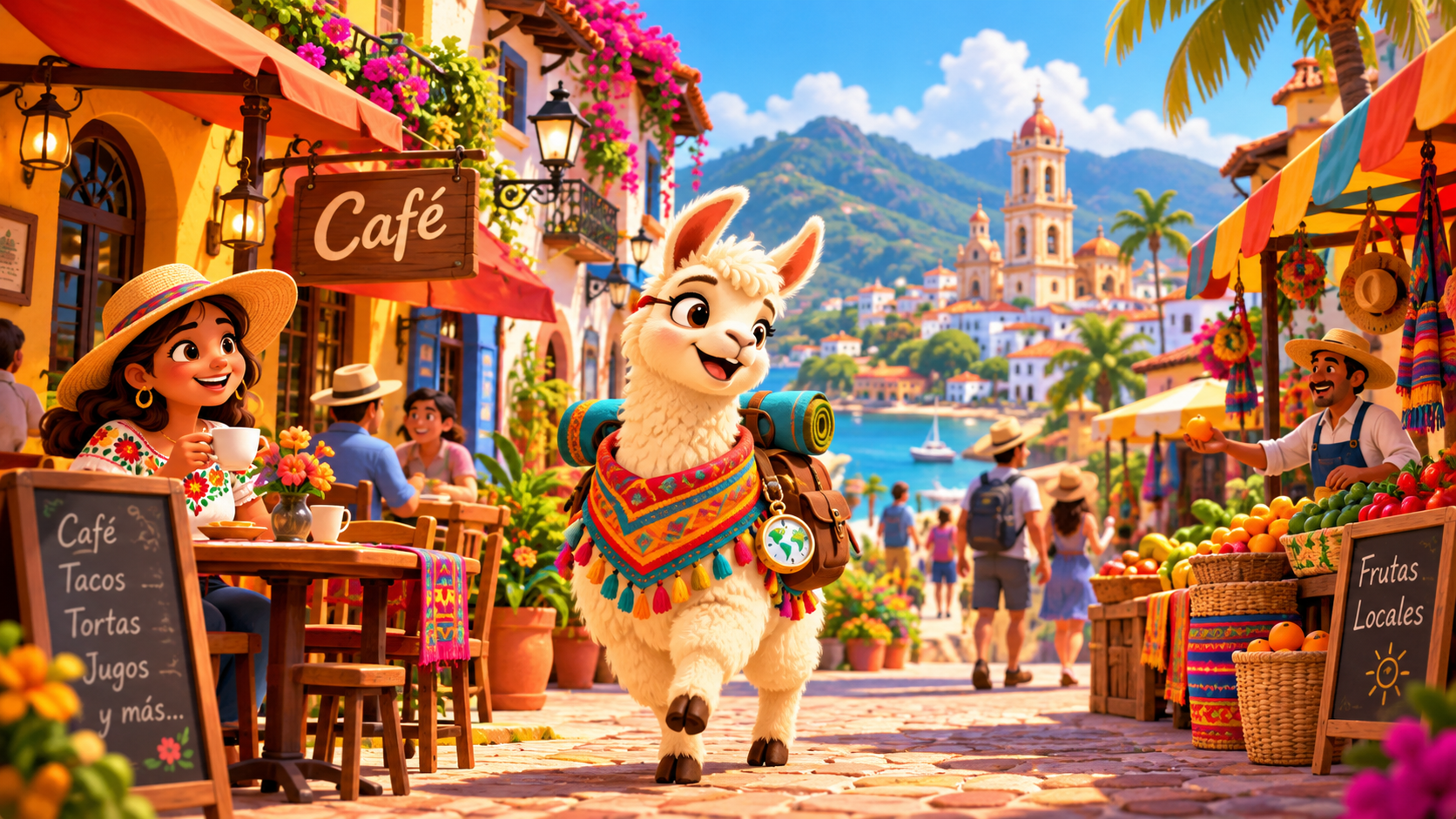
Sol, the Dancing Llama, exploring a colorful Spanish-speaking town, with a café, market, and travelers.
From ordering your first café con leche to asking for directions, a few Spanish phrases can make your next adventure more rewarding.
Picture yourself arriving in a colorful Mexican town, wandering through the streets of Madrid, or exploring a small coastal village in Costa Rica.
You stop at a café, glance at the menu, and realize you have a question.
You could reach for your phone and open a translation app. Or you could try something much more memorable: speaking Spanish.
You don't need to be fluent to enjoy meaningful interactions while traveling. Sometimes, knowing how to greet someone, order a meal, or ask a simple question is enough to make an unfamiliar place feel a little more welcoming.
Here are 25 essential Spanish phrases for travelers, organized around situations you're likely to encounter on your next adventure.
1. Greetings and Everyday Conversations
Every great adventure begins with a hello.
Learning a few greetings is one of the easiest ways to connect with people while traveling.
1. Hola
Hello
Pronunciation: OH-lah
2. Buenos días
Good morning
Pronunciation: BWEH-nohs DEE-ahs
3. Buenas tardes
Good afternoon
Pronunciation: BWEH-nahs TAR-dehs
4. Buenas noches
Good evening / Good night
Pronunciation: BWEH-nahs NOH-chehs
5. ¿Cómo está?
How are you? (formal)
Pronunciation: KOH-moh ehs-TAH
Travel tip: In many Spanish-speaking places, a friendly greeting before asking a question is appreciated.
For example, when entering a small shop, you might say:
“Buenos días. ¿Cómo está?”
Good morning. How are you?
Notice that ¿Cómo está? is a polite, formal way to address someone. With friends or people you know well, you'll often hear ¿Cómo estás? instead.
2. Being Polite Goes a Long Way
A little courtesy can make a big difference, especially when you're communicating in a language you're still learning.
6. Por favor
Please
Pronunciation: pohr fah-BOHR
7. Gracias
Thank you
Pronunciation: GRAH-syahs
8. De nada
You're welcome
Pronunciation: deh NAH-dah
9. Disculpe
Excuse me
Pronunciation: dees-KOOL-peh
10. Lo siento
I'm sorry
Pronunciation: loh SYEHN-toh
Travel tip: Disculpe is particularly useful when politely getting someone's attention, asking a stranger a question, or apologizing for a minor interruption.
For example:
“Disculpe, ¿dónde está el baño?”
Excuse me, where is the bathroom?
It's a sentence worth remembering.
3. Ordering Food and Drinks
Food is one of the most enjoyable ways to discover a culture.
Whether you're ordering tacos in Mexico, tapas in Spain, or coffee in Colombia, these phrases can help you navigate the experience.
11. Quisiera un café, por favor.
I would like a coffee, please.
Pronunciation: kee-SYEH-rah oon kah-FEH pohr fah-BOHR
12. ¿Tiene un menú?
Do you have a menu?
Pronunciation: TYEH-neh oon meh-NOO
13. ¿Qué recomienda?
What do you recommend?
Pronunciation: keh reh-koh-MYEHN-dah
14. La cuenta, por favor.
The bill, please.
Pronunciation: lah KWEHN-tah pohr fah-BOHR
15. Está delicioso.
It's delicious.
Pronunciation: ehs-TAH deh-lee-SYOH-soh
A Simple Restaurant Conversation
Imagine sitting down at a restaurant in Mexico.
You: Buenas tardes. ¿Tiene un menú?
Good afternoon. Do you have a menu?
Server: Sí, claro.
Yes, of course.
You: Gracias. ¿Qué recomienda?
Thank you. What do you recommend?
Later, after enjoying your meal:
You: Está delicioso. La cuenta, por favor.
It's delicious. The bill, please.
That's already a useful little conversation.
And with practice, it becomes increasingly natural.
4. Finding Your Way Around
Getting a little lost can be part of the adventure.
Still, knowing how to ask for directions makes exploring a new city much easier.
16. ¿Dónde está el baño?
Where is the bathroom?
Pronunciation: DOHN-deh ehs-TAH ehl BAH-nyoh
17. ¿Cómo llego al centro?
How do I get to the city center?
Pronunciation: KOH-moh YEH-goh ahl SEHN-troh
18. ¿Está lejos?
Is it far?
Pronunciation: ehs-TAH LEH-hohs
19. A la derecha
To the right
Pronunciation: ah lah deh-REH-chah
20. A la izquierda
To the left
Pronunciation: ah lah ees-KYEHR-dah
Understanding Directions
You might ask:
“Disculpe, ¿cómo llego al centro?”
Excuse me, how do I get to the city center?
Someone might respond with directions that include:
A la derecha: To the right
A la izquierda: To the left
You may not understand every word, but recognizing these common expressions can help you follow along.
Travel tip: If someone speaks too quickly, it's perfectly fine to ask them to slow down. Even when you only understand part of the response, gestures and landmarks can help.
5. Shopping and Everyday Situations
Markets, shops, and local businesses are wonderful places to practice simple conversations.
These phrases are especially useful when you're exploring somewhere new.
21. ¿Cuánto cuesta?
How much does it cost?
Pronunciation: KWAHN-toh KWEHS-tah
22. ¿Aceptan tarjeta?
Do you accept cards?
Pronunciation: ah-SEHP-tahn tar-HEH-tah
23. No entiendo.
I don't understand.
Pronunciation: noh ehn-TYEHN-doh
24. ¿Habla inglés?
Do you speak English?
Pronunciation: AH-blah een-GLEHS
25. ¿Puede hablar más despacio?
Can you speak more slowly?
Pronunciation: PWEH-deh ah-BLAR mahs dehs-PAH-syoh
A Useful Phrase When You're Learning
One of the most valuable sentences on this entire list is:
“¿Puede hablar más despacio?”
Can you speak more slowly?
You don't have to understand everything immediately.
Language learning is a process, and asking someone to slow down can turn a confusing exchange into a learning opportunity.
Spanish Pronunciation: A Few Things to Know
Spanish pronunciation is often more consistent than English pronunciation, but there are some differences worth remembering.
The Letter H Is Usually Silent
In words like hola, the letter h isn't pronounced.
That's why hola sounds approximately like OH-lah, not “HOH-lah.”
The Letter Ñ Has Its Own Sound
The Spanish ñ sounds similar to the ny in the English word canyon.
You'll hear it in words such as baño (bathroom).
The Letter J Sounds Different
The Spanish j generally has a breathy sound, somewhat like an English h, though its exact pronunciation varies by region.
For example, lejos (far) sounds approximately like LEH-hohs.
Pronunciation Changes Across Regions
Spanish is spoken across many countries, and pronunciation varies.
For example, the letters c (before e or i) and z are commonly pronounced differently in much of Spain than in Latin America.
Neither regional pronunciation is inherently more correct.
A note about the guides above: These English-based pronunciation approximations are designed to help beginners get started. They cannot reproduce every Spanish sound or regional accent. Listening to native speakers is the best way to develop more natural pronunciation.
How to Remember Spanish Phrases Before Your Trip
Memorizing a long vocabulary list isn't always the most enjoyable way to prepare for travel.
Instead, try connecting phrases to situations you can imagine experiencing.
Start With Five Phrases
Choose five expressions you're likely to use.
For example:
Hola
Por favor
Gracias
¿Cuánto cuesta?
La cuenta, por favor.
Practice saying them aloud until they feel familiar.
Imagine Real Situations
Picture yourself ordering coffee, asking for directions, or buying something at a market.
What would you say first?
What might the other person say in response?
Practicing a short exchange can be more memorable than studying individual words without context.
Listen and Speak
Reading Spanish is useful, but hearing and speaking it are equally important.
Pay attention to the rhythm of the language and repeat phrases aloud.
Don't worry about sounding perfect.
The goal is to become more comfortable communicating.
Be Curious
Language is more than vocabulary.
It's connected to the people, traditions, food, and everyday experiences that make each destination unique.
The more curious you become about a culture, the more reasons you'll discover to use its language.
Your Next Adventure Starts With a Conversation
You don't need hundreds of memorized sentences to begin connecting with people in Spanish.
A greeting, a polite question, or a few words of appreciation can help you participate more confidently in everyday travel experiences.
Start small. Practice regularly. Stay curious.
And remember: every new phrase opens another little window into the world.
Continue Your Adventure With Voyinga
Ready to explore Spanish in a more playful way?
Step into Fiesta Island, Voyinga's Spanish language world, and meet Sol, the Dancing Llama.
Discover an adventure-driven approach to language learning through interactive activities, memorable characters, and immersive experiences.
Learn a Language. Live the Adventure.